


News
For the Love of Bunnies and Benefits
Does your toddler have a snuggly bunny they LOVE? Then they will LOVE playing this game with their furry friend. For such a little children’s rhyme, there is a lot of learning happening with your expressive interactions and repeated play.
View this post on Instagram
Expand on their Interest
When your child has a strong interest in something, it offers an exceptional opportunity to expand so many areas of their childhood development. Positive emotions attached to learning opportunities result is a longer attention span, interest in repetition, and stronger neural connections for more well-rounded learning. With new and unique ways
to play with their favorite objects, their interest in it will last longer and they become curious to learn more. “What else can I do with this?” This question itself has lifelong benefits for their curiosity and knowledge building.
Language Development
Simply hearing the cadence of rhyme is immersing your child in learning the format and concepts of speech, even in the earliest stages of your baby’s language development. Toddler’s brains are avidly seeking the connection between words and actions, helping with both their receptive language (understanding what others say), and their expressive language (ability to communicate using their own words).
Focused Attention / Observation
When the rhyme says “I see..”, we are reinforcing our child’s observational skills, increase their attention span as they keep looking at an object to find and describe the many things they see with their eyes.
Sign Language
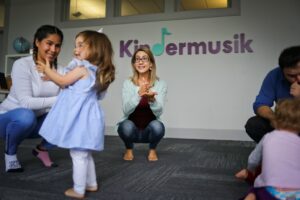 Even when your child can hear perfectly well, using sign language in coordination with speech has cognitive benefits. When a child can SEE and HEAR the word at the same, they are learning two ways to express the same concept, which builds stronger neural connections leading to easier language development AND, there are times you and
your child may want to communicate silently. Using the sign for SEE can be used when you discover a real animal outside and don’t want to scare them, when you are in a quiet place and need to communicate, and so many more life circumstances. Along with the silent mouthing of “Yay” at the end, the wiggling hands in the air is sign language for celebrating. It is also how people who are deaf applaud each other for accomplishments. Having a quiet visual way to celebrate appreciation of your child’s actions can also come in very handy.
Emotional Awareness
“Surprise!” is such a fun facial expression to imitate. AND… It is a fabulous word to use when your child is startled instead of the word “scared”. “Oh, I didn’t mean to surprise you.” may help your child have a more positive reaction, and recover more quickly. As we play around with the facial expressions for sad and happy at the end, two year
olds and preschoolers are learning to read facial expressions and recognize the emotions they are associate with… an amazing start in developing their emotional intelligence.
Turn-Taking prepares for school readiness
At first, you will be chanting the rhyme and moving the bunny. Your child “turn” will likely be to request it again and again. Once the rhyme is familiar, your child may move the bunny while you chant the rhyme. Little step toward letting them take on more of the experience can be leaving off some of the repeated words at the end, and let them say the repeated quiet words. As you continue to leave off more of the ending words their memory for the rhyme is building until they can complete it all themselves. Maybe while you are moving the bunny???
Memorization leads to better reading skills
“Experts in literacy and child development have discovered that if children know eight nursery rhymes by heart by the time they’re four years old, they’re usually among the best readers by the time they’re eight. “- Mem Fox, Reading Magic
Motor Skill Development and Inhibitory Control
As your child moves the bunny along with the rhyme, they are by creating the correct movements in connection with the action words they hear. They are practicing, in a delightful way, when to move and stop, and moving faster and slower. As we highlight how proud they are of this control over their gross motor skills, it will build their desire to
have this control in other situations.
By using two FINGERS outward from a fist, your “hand” bunny can move along with this rhyme and help develop their fine motor skills as well. This can be a great game to play while waiting in line at the grocery store, or in a doctors office. No props needed.
Musical awareness
Last, but not least, this rhyme introduces opposing concepts in a perfect way to develop early childhood development in cognition and music, at first in awareness and progressing toward active skills:
Loud and quiet are introduced by the repeated sounds, with the first three louder and followed by more with a quiet voice.
Crescendo (getting louder) and Decrescendo (getting louder) as well as melodic direction (the pitcho going up and down are introduced with the “bloops” as the bunny hops away (starting loud with a higher pitch) and hops back (starting with a quiet and lower pitch).
Ready for more?
 Now that your child is ready to expand connections to their favorite bunny friend, you can continue to add more. Download the free Kindermusik APP on any mobile device, and enjoy these songs. Once in, click on the MUSIC tab at the bottom, tap on SONGS at the top, and search for RABBIT. “I Saw a Little Rabbit” and “Usagi, Usagi”
When you and your child participate in our Kindermusik classes with our accredited educators at Grow and Sing Studios, we’d love to hear what your child’s interests are so we can provides songs and activities to expand the things that bring them joy. We have so many resources to make it a little easier for you to connect with your child and
provide life-long benefits in their development. A big bonus when you enroll is accessing a much larger selection of music, books, and more on the Kindermusik App.
Sign up to Preview a Class with us today and see the magic in action.
If you have some favorite rhymes, songs or stories about bunny rabbits you would
recommend to other parents, please share in the comments!
Testomonial from a Kindermusik Mom – Grow and Sing Studios, Orlando, FL
What a wonderful testimonial and peak into our Kindermusik classroom!
******************************************************************
“Thank you to Grow and Sing Studios for inviting us to experience Kindermusik in Lake Nona, connecting through the magic of music! {Hosted}
As a mama, I’m always nervous with how my toddlers will react in new spaces. Seriously, you never know what you’ll get! Today, Ms. Grace welcomed us with open arms and an open heart. She quickly recognized that MJ had strong emotions, and met her where she was. Through music and movement, it was beautiful to see the curiosity and wonder light up in MJs eyes as she engaged a safe distance away. 🥰
🎶 Kindermusik takes musical learning to the next level. In every Kindermusik class, babies and toddlers are welcomed into a playful and nurturing environment where they will sing, move, play instruments, and hear stories—all while developing social skills, problem-solving skills, pre-math skills, and a foundation for reading.
Their research-based curriculum focuses on whole-child development and helps caregivers understand how their child is developing musically, cognitively, and socially.
Classes are available for babies and toddlers.
Summer 2024 Kindermusik Registration is OPEN! Check out the link in stories.
If you’re looking for a safe and educational indoor activity this summer for your babies and toddlers, we recommend checking them out.
View this post on Instagram
Things to do Orlando, baby activities, toddler activities
Newborn Sensory Play: Exploring Scarf Play with Music
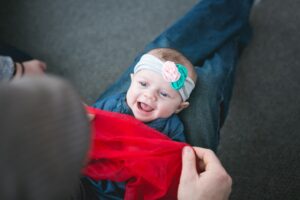 Scarf play with music for a newborn? OH YES! Discover the magic of scarf play with music for your newborn and how it can engage their senses and promote development.
Multi-Sensory Stimulation:
As your baby feels, touches and sees the scarf moving, and hears the music match the movements, so many of their senses are sending messages to the brain all at the same time. In turn, your baby’s brain is absorbing and integrating this sensory information, building neural connections that can become automated awareness, leaves their brain energy for new things to learn.
Interactive Play for Development:
Because infants rely on interactive play with a loving family member to stimulate them, calm them, and enable them feel joy… all which are key to optimal infant development, scarves offer a gentle way to accent your play and spark creativity.
Incorporating Scarf Play in Family Time:
Mommy and me music playtime with a scarf can provide all of that… moving the scarf along with vocal play, describing words, upbeat tunes or sweet lullabies. Daddy and me activities can be a bit more robust, holding baby up to their chest facing out, and marching through the room with a scarf hanging over their legs… swishing on their skin with the movement. Siblings can lay down in front of Baby, facing them for some delightful infant tummy time playing peek-a-boo, or bouncing the scarf to the beat of rhymes they chant. Scarves are actually a wonderful prop for infant play with your whole family seated in a circle around them tossing the scarf to each other and peeking out at baby in turn.
Understanding Your Baby’s Sensory Sensitivity:
Be aware, each baby has their own sensory sensitivity. Now is a good time to carefully watch to see what your baby is communication to you and adjust accordingly. When your baby seems to avoid or whimper during scarf play, you may need to slow down, start with just visual play or only gently touch extremities. Often young babies can become averse to scarf play when it is immediately used on their face and it may freak them out since they don’t understand it. Any peekaboo play should start with your own face, and they will love it. Once your baby knows what to expect, and enjoys this multi-sensory play, they may be eager for more close to the face movement and robust movements.
Enhancing Scarf Playtime:
Try this: Start with vocalizing on “aah” or “ooh” going higher or lower in pitch MATCHING the movements of the scarf above them as they are laying on the floor. (They love your voice, even if you don’t.) You may include describing words to add the benefit of language development. Use directional words such as up-down, around, over-under, in-out, or action words like swoop, swish, swirl, hop, jump, etc.
Add a personal touch by singing your baby’s name. As you slowly move the scarf upward, focus on the first vowel in their name as the pitch in your voice slowly climbs higher before finishing their name in a playful way. Enjoy the same going lower until the scarf rests on their belly. If they reach for it, let them bat it around and maybe even grab it and pull it in toward the center of their body.
Enhance your play by playing some instrumental music and move the scarf along with the flow of pitch, with small movements for quiet music and bigger movements for louder music.
Benefits of Scarf Play:
As a tiny infant, your baby may not be moving their head side to side yet, so seeing the bright blurry scarf flow above them, and hearing the pitch of your voice sync with the scarf movement is an incredible learning experience. As your baby starts to move their head side to side, they are eager to practice and develop their independent eye tracking to watch the scarf glide across their vision.
As your baby reaches for the scarf, they are practicing their ability to extend their extremities, and as they grab at it and pull it in, they are practicing their ability to flex and hold, critical gross motor skills for infants. Stephanie Johnson, in her book “Baby Bare” calls the first three months of a baby’s life the “Squishies” stage, and these specific visual and motor skills are the first most important aspects of their critical early development.
Before babies can try to imitate anything, their brain is programmed to learn quite complex concepts from their experiences. Babies’ brains are primed to create neural pathways for intervals and math through the more rich classical and jazz music. Simply listening is a delightful background for their daily experiences, but interactive play while listening is when the real learning occurs. Once a child begins to try to imitate, we adapt it for their singing range and capabilities.
Choosing the Right Music:
The barbershop quartet version of “Home Sweet Home” on the free Kindermusik APP (available for any mobile device) is found in the Theme: Relaxation, and has a wonderful high and low flow, perfect for scarf play. For a delightful song with verbal directions, enjoy “Up, Up in the Sky” with your little bird. Download the APP today for music YOU will love to listen to repeatedly as well.
Next Step….Kindermusik!
For an ongoing supply of new ideas and music you can use together with your baby, join us anytime during your infant’s first three months with our special Newborn Offer. If your baby is older, sign up today to Preview a Class and see the musical magic in action with other families with newborn infants, and babies up to walking.
View this post on Instagram
We hope this inspires you to embrace scarf play with music as a valuable tool for newborn sensory development, fostering a strong bond and providing enriching experiences for your baby.
With Music and Magic,
Team Grow and Sing Studios